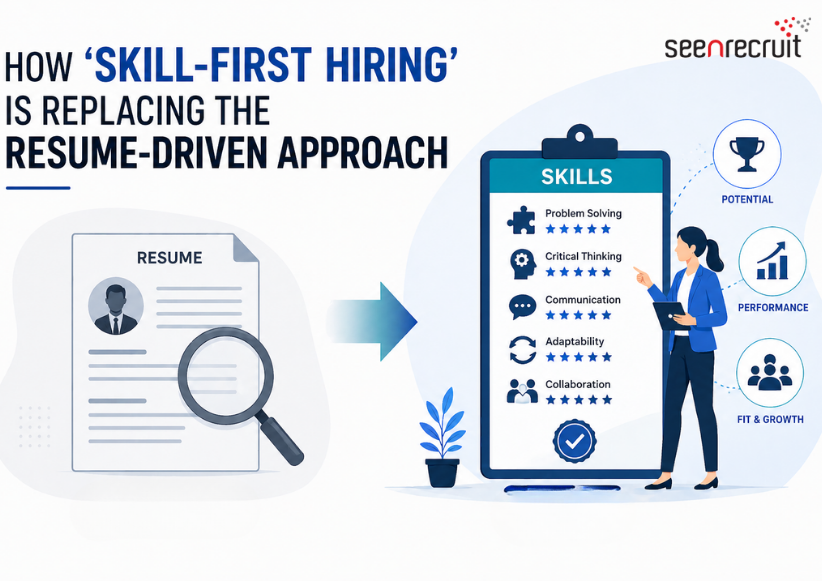


Resumes are taking a backseat as companies shift toward skill-first hiring, prioritizing real capabilities over credentials. Explore how companies transform hiring by prioritizing a candidate’s skills and potential, rather than relying solely on past job titles and resumes. Discover why this approach leads to stronger teams, greater diversity, and better job matches.
The recruitment playbook is getting rewritten in a world where job titles evolve faster than degrees. Enter skill-first hiring—a transformative approach that prioritizes capability over credentials. No longer are resumes the definitive markers of potential. Employers are shifting their focus to what counts—candidates’ actual skills and abilities, rather than just their past roles or experience.
Skill-first hiring evaluates a candidate’s core competencies, technical skills, and adaptability rather than trusting solely on degrees, job titles, or past employers. It’s a competency-based recruitment model that aligns perfectly with the demands of the modern workforce—agile, tech-enabled, and outcome-driven.
Think of it as Hiring for Potential, NOT just Pedigree
Traditional resumes often fail to tell the complete story. They’re heavily focused on:
This outdated approach excludes a vast pool of capable candidates—especially career changers, self-taught professionals, gig workers, and those from non-traditional backgrounds.
Forward-thinking companies now use real-world simulations, technical challenges, and behavioral assessments to gauge on-the-job capabilities. Some even conduct blind hiring to remove bias altogether.
These methods enable fair, inclusive, and performance-centric hiring.
Major players like Google, IBM, and Accenture have already dropped degree requirements for many roles. Instead, they now emphasize certifications, practical experience, and demonstrable skills.
Startups and mid-sized firms, too, are leveraging skill-based hiring platforms like HackerRank, Codility, Vervoe, and TestGorilla to cut through resume noise and find actual performers.
Hiring for skills also supports future-proofing your workforce during rapid tech change.
The good news is clear if you’re a candidate: Your skills are your currency.
To stay competitive:
The shift toward skill-first recruitment is more than just a trend—it’s a strategic evolution. With roles in AI, fintech, clean tech, and digital transformation exploding, skills over degrees are no longer a nice-to-have but a necessity.
Companies that embrace this change are unlocking hidden talent, driving innovation, and building resilient, high-performing teams.
As the future of work continues to evolve, the most innovative organizations are flipping the hiring script. It’s no longer about where you’ve been but what you can do. Skill-first hiring is not just replacing the resume—it’s reimagining recruitment.