

Explore why balancing profit and ethics is a defining leadership challenge in 2026. Learn how ethical leadership, AI governance, and transparency shape sustainable business growth.
In 2026, leadership is being tested on far more than commercial performance. Revenue, growth, and profitability continue to matter, but they are no longer the only measures of success. Increasingly, businesses are being evaluated on the quality of their decisions, the integrity of their leadership, and the principles that guide their growth.
This shift has made one issue impossible to ignore: the balance between profit and ethics.
As businesses scale amid digital acceleration, AI-led transformation, and heightened stakeholder scrutiny, leaders are under growing pressure to deliver strong financial outcomes without compromising responsibility, transparency, or trust. What was once treated as a values discussion has now become a strategic leadership imperative.
The business environment has evolved. Markets are more transparent, stakeholder expectations are sharper, and reputational risk moves faster than ever. In this climate, leadership decisions are not assessed in isolation. They are examined through the lens of governance, workplace culture, technology use, and long-term accountability.
In this context, ethics is no longer peripheral to strategy. It is embedded within it.
For a long time, businesses often approached profit and ethics as competing priorities. Growth was seen as urgent and measurable; ethics was viewed as important, but secondary. That distinction is becoming increasingly unsustainable.
In reality, the cost of ethical compromise is now far greater than many organizations can afford.
Short-term financial wins may appear attractive, but they rarely compensate for long-term reputational or organizational damage. In contrast, businesses that align commercial ambition with ethical clarity are often better equipped to scale with resilience.
Ethical leadership in 2026 is not defined by idealism. It is defined by judgment. It reflects a leader’s ability to make commercially sound decisions while protecting the long-term interests of the business, its people, and its stakeholders.
The strongest leaders today understand that sustainable growth depends on more than speed. It depends on trust.
This is no longer a soft leadership quality. It is a business-critical one.
Few areas highlight the tension between profit and ethics as clearly as artificial intelligence. In 2026, AI is influencing everything from hiring and customer engagement to analytics, risk management, and productivity.
The opportunity is significant. So is the responsibility.
These are no longer purely technical concerns. They are leadership concerns. Responsible AI governance has become essential for organizations that want to innovate credibly and grow confidently.
A premium brand today is not built by visibility alone. It is built on credibility. And credibility is increasingly shaped by transparency.
Stakeholders in 2026 expect organizations to communicate clearly and operate honestly. Whether the subject is pay structures, culture, diversity commitments, sustainability, or governance, there is far less tolerance for ambiguity and far greater expectation of alignment between message and reality.
When businesses fail to match narrative with action, trust declines quickly. When they communicate clearly and operate consistently, they build stronger long-term equity.
The relationship between ethics and talent has become increasingly direct. High-quality professionals are not simply choosing roles based on salary, designation, or brand name. They are assessing the credibility of leadership, the fairness of workplace culture, and the values an organization actually lives by.
For this reason, ethics is not only a governance issue. It is a decisive factor in talent strategy and organizational reputation.
Balancing profit and ethics requires more than good intent. It requires deliberate systems, disciplined decision-making, and visible leadership ownership.
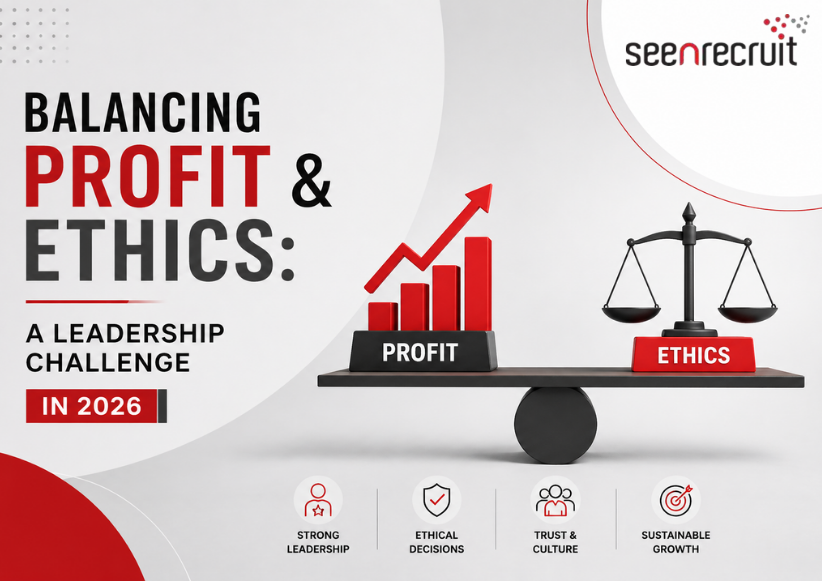
The real challenge is not choosing between performance and principles. It is building a business where both can coexist — and reinforce each other.
Profit remains essential. It always will. But in today’s business climate, how that profit is generated matters just as much as the result itself.
The organizations that will command the greatest respect in 2026 will be those led with clarity, discipline, and conscience. They will understand that ethical leadership is not a barrier to growth, but a foundation for sustainable success. They will recognize that governance, transparency, trust, and responsible innovation are no longer optional ideals. They are essential business assets.
In an era defined by visibility, complexity, and rising expectations, balancing profit and ethics is no longer a passing discussion. It is one of the most important leadership tests of our time.