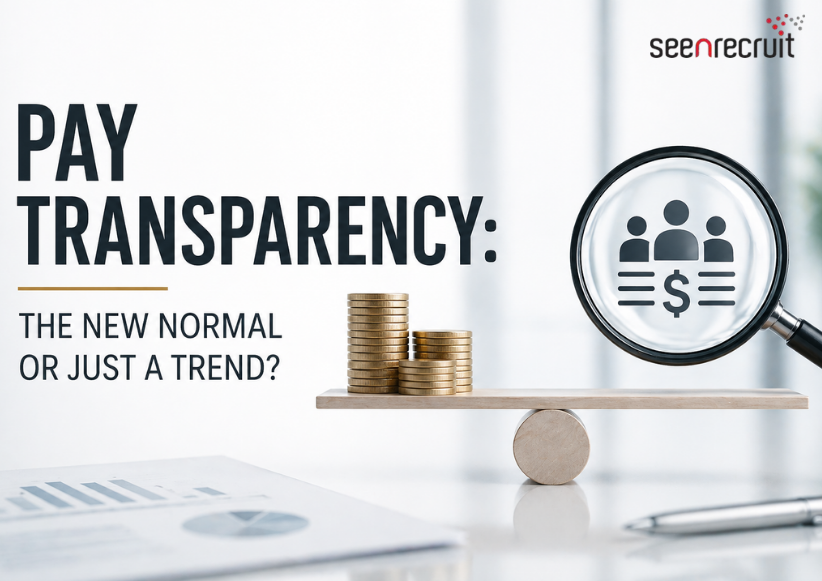


Is pay transparency the future of hiring or a passing workplace trend? Explore how salary transparency is reshaping recruitment, employer branding, pay equity, and candidate trust in 2026.
For years, compensation was treated like a closed-door conversation. Salary discussions were often delayed, avoided, or hidden behind phrases like “best in the industry” or “as per market standards.” That approach is changing fast. In 2026, pay transparency is no longer just an HR talking point. It is becoming a defining factor in how companies attract talent, build trust, and stay competitive in the hiring market. Recent employer guidance and compliance updates show that salary disclosure requirements are expanding, and many organizations are moving from basic compliance to using transparency as a talent strategy.
So, is pay transparency the new normal or just another workplace trend? The answer is becoming clearer: it is quickly moving toward normal.
Pay transparency refers to how openly an organization communicates compensation information. This can include sharing salary ranges in job postings, explaining how pay decisions are made, disclosing bonus structures, and clarifying promotion-linked compensation. In some markets, employers are now legally required to provide salary or hourly pay ranges in job ads or during the hiring process. WorldatWork reported in early 2026 that 15 U.S. states and seven counties or cities had enacted pay transparency laws, with requirements often extending beyond salary ranges to benefits and incentives.
This matters because today’s candidates want more than opportunity. They want clarity. When employers avoid salary conversations, applicants often assume the worst: lowballing, inconsistency, or internal inequity. Transparent compensation communication reduces this friction and improves the candidate experience.
One major reason is regulation. Pay transparency laws are growing across jurisdictions, and employers with multi-location hiring needs are under increasing pressure to standardize compensation communication. SHRM noted in 2025 that 14 states plus Washington, D.C. had enacted pay transparency laws, while additional states were considering similar measures; by early 2026, WorldatWork reported that the number had grown further.
The second driver is candidate expectations. In a market where top talent evaluates employers just as closely as employers evaluate candidates, opaque pay practices can slow down decision-making and weaken offer acceptance. Hiring commentary and HR trend coverage in 2026 increasingly frame pay transparency as something candidates now expect rather than view as a bonus.
The third driver is pay equity. Transparency helps companies identify gaps, defend compensation decisions, and strengthen workplace fairness. WorldatWork has emphasized that organizations need refreshed compensation philosophies and defensible pay frameworks as transparency and pay equity reporting rules tighten.
Not really. Trends usually fade when market attention shifts. Pay transparency is doing the opposite. It is being reinforced by legislation, candidate demand, and employer brand strategy. SHRM described 2026 as a tipping point, with pay transparency shifting from compliance to competitive advantage.
That said, not every company is equally ready. Some businesses still post broad salary bands without context. Others disclose pay ranges externally but lack internal alignment on performance benchmarks, increments, or promotion logic. SHRM also noted in 2025 that while laws are driving changes in practice, workplace culture can take longer to catch up.
So, the real question is not whether pay transparency is temporary. It is whether organizations will approach it strategically or reactively.
For employers, pay transparency is now linked to talent acquisition, employer branding, candidate trust, and employee retention. A clear salary range can reduce irrelevant applications, improve screening efficiency, and create more productive interviews. It also signals organizational maturity.
However, transparency without structure can backfire. Companies need a defined compensation philosophy, role benchmarking, internal parity checks, and manager readiness. If employees ask why two similar roles fall into different salary bands, leadership must be able to answer confidently and consistently.
Pay transparency is not just a passing hiring trend. It is becoming a new workplace standard, especially for companies that want to stay credible in a more informed, compliance-driven, and candidate-led market. The winners will not be the employers who simply reveal numbers. They will be the ones who build fair, explainable, and future-ready compensation systems around them.
In 2026, silence around pay does not create mystery. It creates doubt. And in hiring, doubt is expensive.