

Explore how conflicts of interest in real estate create hidden ethical risks for developers, investors, brokers, and employers. Learn why transparency, governance, and ethical leadership matter more than ever in real estate hiring and business decisions.
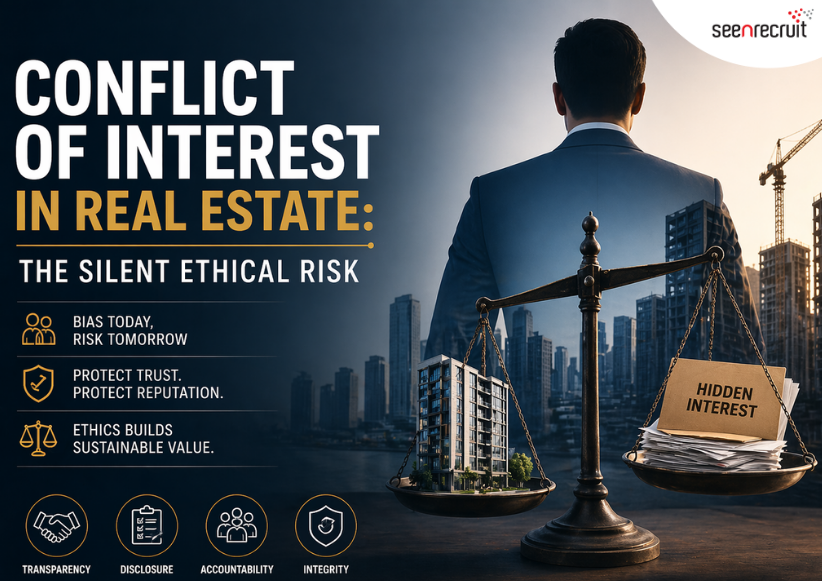
In real estate, trust is everything. Deals are built on relationships, negotiations, insider knowledge, and long-term credibility. But behind many successful transactions lies a risk that often goes unnoticed until the damage is done: conflict of interest in real estate. It is one of the most silent yet serious ethical challenges facing the industry today.
From brokers representing multiple parties to decision-makers favoring personal connections over fair processes, conflicts of interest can quietly erode business integrity. In an industry already shaped by high-value transactions, regulatory pressure, and reputation-sensitive networks, even a small ethical lapse can trigger long-term consequences.
A conflict of interest happens when a professional’s personal interest, financial gain, or outside relationship interferes with their duty to act in the best interest of a client, employer, investor, or stakeholder. In real estate, these situations are often subtle. They may not always look illegal on the surface, but they can still be deeply unethical.
These practices may stay hidden for a while, which is exactly why they are so dangerous.
Unlike obvious fraud or financial misconduct, a conflict of interest in real estate does not always create immediate alarms. The transaction may still close. The numbers may still look good. The project may still move forward. But beneath the surface, the foundation of ethical decision-making begins to weaken.
This is especially relevant in sectors such as commercial real estate, residential real estate, proptech, real estate investment, construction management, and real estate private equity, where overlapping networks and fast-paced dealmaking are common. When transparency is compromised, objectivity disappears. Over time, that affects not just one transaction but the organization’s culture.
The real cost of ethical blind spots is much bigger than most firms realize. A conflict of interest can lead to:
Today’s real estate market is evolving quickly. With rising investor expectations, ESG conversations, digital transformation, and sharper scrutiny around governance, ethical leadership is no longer optional. Companies that ignore conflicts of interest risk appearing outdated, unprofessional, and unsafe to work with.
For leadership teams, the issue is not just about avoiding wrongdoing. It is about building a culture in which decisions are fair, transparent, and well-documented. That matters across every level of the business, from acquisitions and sales to procurement, vendor selection, finance, and hiring.
Preventing conflict of interest starts with clarity and accountability. Organizations should focus on:
Conflict of interest in real estate is a silent ethical risk because it often hides behind business-as-usual decisions. Yet its impact can be severe, affecting trust, compliance, culture, and long-term growth. In an industry where credibility is capital, ethical clarity is a strategic advantage.
For real estate firms looking to scale sustainably, the message is clear: success should never come at the cost of integrity. The organizations that lead the future of real estate will not just be known for closing deals, but for how ethically they do it.