

Discover how workforce strategy is influencing investment and expansion decisions in 2026. Learn how talent planning, leadership hiring, and workforce analytics drive scalable business growth.
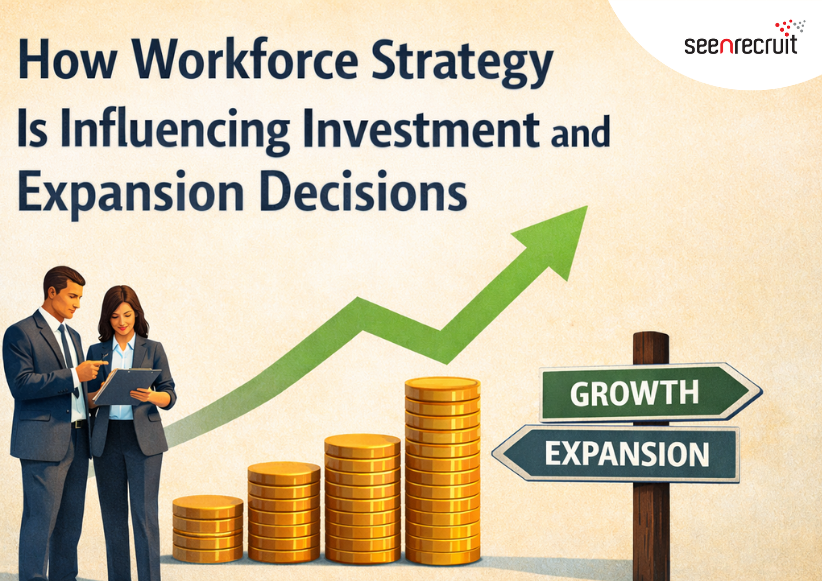
Business growth is no longer determined solely by access to capital or favourable market conditions. The real differentiator behind successful expansion is workforce strategy. As companies scale across geographies, sectors, and digital capabilities, leaders are increasingly realising that people strategy directly influences investment outcomes.
In 2026, organisations are no longer asking “Where should we expand?” — they are asking “Do we have the talent to expand sustainably?”
This shift has made workforce planning a critical component of investment and expansion decisions across industries.
Traditionally, expansion strategies were built around infrastructure, cost efficiency, and market opportunity. Today, those factors are incomplete without understanding workforce readiness.
Regions with strong talent ecosystems are increasingly preferred over low-cost locations that lack skilled labor. As a result, strategic workforce planning has become a core input into location strategy and market-entry decisions.
For investors, workforce strength is now a major indicator of long-term value creation. During mergers, acquisitions, or funding rounds, talent metrics are assessed alongside financials.
A weak workforce strategy can delay growth, increase operating costs, and impact customer delivery. This is why human capital due diligence has become a standard part of investment evaluation.
Simply put, a strong talent strategy improves valuation confidence.
When organisations scale, they must decide how to acquire talent:
The right combination of these approaches determines how fast a business can expand without compromising quality or culture. Companies with a clear workforce roadmap can enter new markets faster, reduce hiring risks, and control operational costs more effectively.
While capital is accessible, skilled talent remains scarce—especially in roles such as:
This shortage has made skills-based workforce planning essential. Organisations are using workforce analytics to forecast future talent needs, assess hiring risks, and plan leadership pipelines well in advance. Forward-looking companies treat workforce data as a strategic asset, not an HR metric.
In M&A scenarios, integration success depends largely on people, not just processes. A strong workforce strategy helps organisations:
Companies that prioritise workforce planning during mergers achieve faster synergies and higher post-deal stability.
Modern expansion is no longer limited by geography. Hybrid work models, global capability centres (GCCs), and remote teams are redefining how companies scale. Workforce strategy now supports:
This flexibility allows organisations to expand intelligently while controlling overheads and improving resilience.
No expansion strategy succeeds without strong leadership. Companies are increasingly investing in:
Leadership gaps are one of the biggest risks during rapid expansion. A robust workforce strategy ensures continuity, stability, and long-term scalability.
In 2026, the workforce strategy has evolved from an HR function into a core business driver. It directly influences investment decisions, expansion planning, operational efficiency, and long-term competitiveness.
Organisations that align talent strategy with business goals are better equipped to:
In a talent-driven economy, the companies that win are those that treat people strategy as a growth strategy.