

Explore the latest succession planning hiring trends driving unprecedented CHRO demand in 2026. Learn how strategic workforce planning, leadership pipeline development, talent mobility, and data-driven HR are reshaping executive hiring and future-ready organizations.
What was once a checkbox activity, succession planning is now a critical driver of long-term business continuity. As organizations navigate digital transformation, hybrid work models, and shifting competitive pressures, the demand for visionary Chief Human Resources Officers (CHROs) is surging. The reason? A renewed focus on leadership pipeline development, workforce agility, and talent forecasting that only seasoned HR executives can deliver.
In this article, we decode the succession planning hiring trends fuelling CHRO demand, supported by the latest insights.
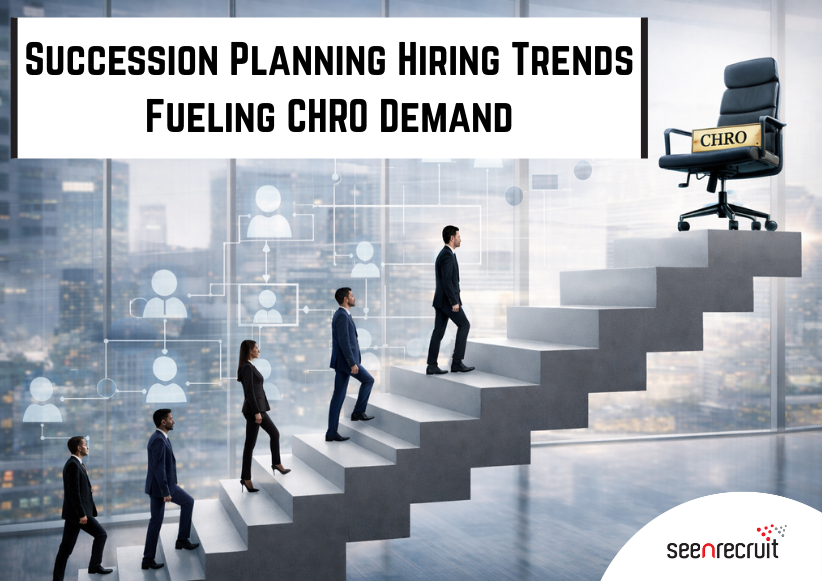
One of the most influential succession planning hiring trends in 2026 is the prioritization of a robust leadership pipeline. Boards and CEOs are no longer content with reactive hiring; they want predictive talent strategies that prepare companies for disruption.
This shift places leadership development at the core of HR strategy. Businesses recognize that succession gaps at key nodes — such as functional heads and business unit leaders — can derail growth. CHROs who combine strategic foresight with execution capability are in exceptionally high demand as a result.
Another pivotal trend reshaping CHRO hiring is the integration of HR analytics and predictive workforce planning. Modern succession planning harnesses data to identify readiness, assess skill gaps, and forecast future needs.
These tools enable HR leaders to build evidence-based talent strategies rather than relying on intuition. As a result, the market for CHRO candidates with deep experience in data-driven HR and business intelligence is growing rapidly.
Today’s workforce values growth opportunities. Consequently, talent mobility — the strategic movement of employees across roles, functions, and geographies — is becoming a core succession planning tactic.
Fostering internal mobility not only strengthens succession pipelines but also improves employee engagement and retention. Organizations that excel at talent mobility see lower turnover and deeper leadership bench strength — making the CHRO’s role central to business success.
Diversity, Equity & Inclusion (DE&I) is no longer an HR buzzword — it’s a measurable business priority. In succession planning, inclusive hiring practices ensure that leadership pipelines reflect varied perspectives and lived experiences.
As boards integrate DE&I goals into executive performance metrics, demand for CHROs with expertise in inclusive succession planning has hit an all-time high.
The post-pandemic world has made hybrid and remote work a long-term reality. Workforce models that emphasize flexibility require CHROs to rethink how they identify and develop future leaders.
This emphasis on skills reinvention and hybrid readiness has redefined what boards seek in a chief HR officer. Those who can architect agile succession plans that accommodate evolving work modalities are commanding premium demand.
Succession planning isn’t just inward-facing. Organizations are recognizing that strong employer branding and candidate experience strategies amplify internal leadership attraction and retention.
A compelling employer brand coupled with transparent succession practices strengthens talent pipelines and accelerates leadership readiness — further enhancing CHRO value.
Finally, the executive recruitment landscape itself is being reshaped by globalization, digital disruption, and competitive talent wars. CHROs with experience across sectors — such as tech, BFSI, and real estate — are especially sought after.
This trend underscores that succession planning is no longer siloed within HR; it is entwined with enterprise strategy, elevating the CHRO seat across industries.
Succession planning in 2026 is strategic, measurable, inclusive, and highly competitive. Organizations that fail to align leadership development with business imperatives risk talent gaps that hinder growth. At the same time, the demand for CHROs — especially those with data fluency, DE&I proficiency, and hybrid work leadership — continues to soar.
For executive search partners, HR professionals, and business leaders, understanding these succession planning hiring trends isn’t optional — it’s essential for building resilient, future-ready organizations.