

Explore what CEOs and boards in India expect from CHROs in 2026, from AI-ready workforce strategy and GCC talent planning to succession, culture, and business-aligned HR leadership.
In 2026, the CHRO in India is no longer expected to function only as the custodian of HR operations. The role has become far more strategic. CEOs and boards now want CHROs who can influence business growth, build future-ready leadership, strengthen culture, and prepare the workforce for AI-led transformation. This shift mirrors broader leadership priorities: recent 2026 CEO research shows that adopting AI, driving revenue growth, and attracting top talent are among the top executive priorities, with leaders also placing growing emphasis on AI governance, ethics, and risk.
For Indian businesses, this expectation is even more pronounced. With GCC expansion, digital transformation, leadership churn, and increasing pressure on productivity, CHROs are being evaluated not just on hiring outcomes but on enterprise value creation. That is why the CHRO agenda in India is becoming closely tied to business resilience, succession depth, and workforce strategy.
Indian CEOs and boards want CHROs who understand numbers, market shifts, capability gaps, and growth priorities. HR can no longer operate in a silo. The boardroom now expects CHROs to translate talent strategy into business impact. This means CHROs must move beyond reporting attrition rates and engagement scores in isolation. They are expected to explain how talent decisions affect growth, productivity, customer outcomes, innovation, and risk management. SHRM’s 2026 CEO research explicitly ties workforce strategy to revenue objectives and digital transformation, reflecting the growing demand for commercially minded HR leadership.
AI is no longer a future discussion. It is a current business mandate. CEOs across markets are increasingly asking whether their organizations are transforming fast enough to keep pace with technology, including AI. PwC’s 2026 CEO findings show that many CEOs are already seeing revenue gains and cost benefits from AI, though returns remain uneven, making workforce execution and change management even more important. That is where the CHRO comes in.
For companies in BFSI, real estate, fintech, and GCC-led ecosystems, this expectation is particularly relevant. CHROs are increasingly being asked to build an AI-ready workforce, not just support training calendars.
India’s GCC story is also reshaping CHRO expectations. EY’s recent India research shows that GCCs are evolving from cost-driven delivery units into innovation-led strategic hubs, with mature centers focusing more on access to talent, innovation, digital transformation, and enterprise impact. This has major implications for HR leadership. Boards and CEOs now expect CHROs to build a differentiated employee value proposition, attract niche digital talent, and improve leadership depth in highly competitive talent markets such as Bengaluru, Hyderabad, Pune, Gurugram, and Mumbai. In many cases, CHROs are also expected to help GCCs move from capability to influence inside the enterprise.
Boards in India are becoming increasingly sensitive to leadership continuity. With business transformation accelerating, companies need future-ready leaders who can manage ambiguity, growth, compliance, and technological disruption simultaneously. That is why succession planning is no longer an annual HR exercise. It is a board-level priority. CHROs are expected to identify internal successors early, build leadership pipelines below the C-suite, and ensure the organization has the bench strength needed for scale.
In 2026, culture is not being judged by intent alone. CEOs and boards want culture to enable execution. In India’s fast-moving talent market, CHROs are expected to create workplaces that support accountability, adaptability, trust, and sustainable performance. This is especially important as companies balance hybrid work, AI disruption, employee expectations, and leadership fatigue. A strong culture today is one that can retain high performers, support transformation, and reinforce business discipline.
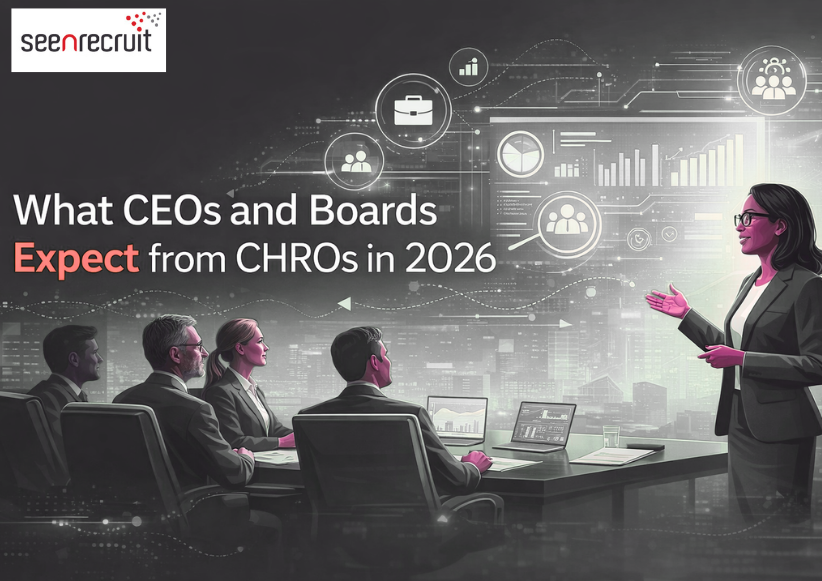
What CEOs and boards in India expect from CHROs in 2026 is clear: stronger business alignment, smarter workforce planning, sharper succession strategy, stronger culture, and real contribution to growth. For firms building leadership pipelines in sectors such as BFSI, real estate, fintech, and GCCs, the CHRO is now a strategic partner in enterprise success. The leaders who will stand out are those who can connect talent strategy, AI transformation, leadership development, and business outcomes into a single compelling boardroom narrative.