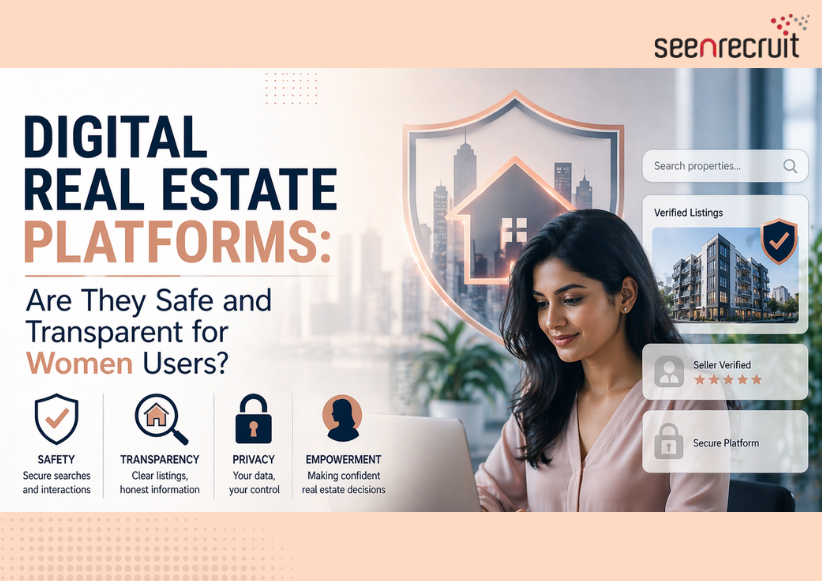


Are digital Real Estate platforms safe for women users? Explore the risks, safety features, transparency gaps, and what women should check before renting or buying property online.
Property search behavior has undergone a significant transformation. What once required multiple broker calls, site visits, and endless follow-ups can now begin with a smartphone screen. With online listings, virtual walkthroughs, digital paperwork, and price comparison tools, real estate platforms have streamlined the home-buying journey, making it quicker and more convenient than ever before.
For women users, this digital shift can feel especially empowering. It allows greater privacy, better control over the search process, and more independence in evaluating options without relying entirely on offline networks. But while technology has undoubtedly made real estate more convenient, one question still deserves serious attention: are digital real estate platforms truly safe and transparent for women users?
One of the biggest strengths of a digital real estate platform is access. Women can search for rental homes, compare neighborhoods, explore amenities, check prices, and shortlist properties at their own pace. This reduces pressure and creates a more informed decision-making process.
In a market where time, mobility, and safety all matter, digital platforms bring several advantages:
For many women, this creates a sense of autonomy that traditional property search methods often lacked.
Despite the benefits, convenience should never be mistaken for complete trust.
A sleek app, a polished property image, or a “verified” label can create the impression that every listing has been thoroughly vetted and is risk-free. In reality, users still need to be cautious. Property fraud, fake listings, misrepresented owners, duplicate-deposit scams, and misleading rental terms can still occur in digital environments.
This is particularly important when discussing women’s safety in real estate. Safety is not just about legal transparency. It also includes questions like:
These are not small concerns. For women users, trust in real estate is both a transaction issue and a personal safety issue.
A truly transparent PropTech platform should do more than simply list properties. It should actively help users evaluate whether a property is worth trusting. That means the platform should ideally offer:
Without these features, digital real estate can become convenient on the surface but unclear underneath.
Even on modern platforms, women users must remain alert at every step of the journey.
A platform can help discover a property, but it cannot replace personal due diligence. Before making any payment or commitment, women users should verify ownership, check project or property credentials, confirm rental terms in writing, and avoid sharing unnecessary personal information early in the process.
It is also wise to be careful about offline meetings. If a site visit is arranged through a platform, the meeting should ideally take place during the day, with location details shared in advance and preferably with someone informed about the visit.
The truth is simple: safe home buying and renting online still requires both platform responsibility and user awareness.
Yes, and that is the encouraging part.
The rise of PropTech in India has pushed the industry toward greater digitization, better discovery tools, and more structured experiences. Digital platforms are helping bring more visibility to inventory, pricing, and buyer behavior. They are also making real estate more accessible to young professionals, first-time buyers, and women making property decisions independently.
But the market is still evolving. Trust is growing, yet it has not fully caught up with technology. That is why the most reliable platforms are those that combine digital ease with robust verification, privacy safeguards, responsive support, and transparent processes.
So, are digital real estate platforms safe and transparent for women users?
They are certainly becoming more useful, more sophisticated, and in many cases more trustworthy than traditional informal routes. But safety and transparency still depend on how seriously a platform handles verification, privacy, and accountability.
For women users, the ideal digital real estate experience is not just fast. It is informed, secure, and respectful of their need for both control and confidence.
In the end, technology can simplify the property journey, but trust is what makes it truly empowering.