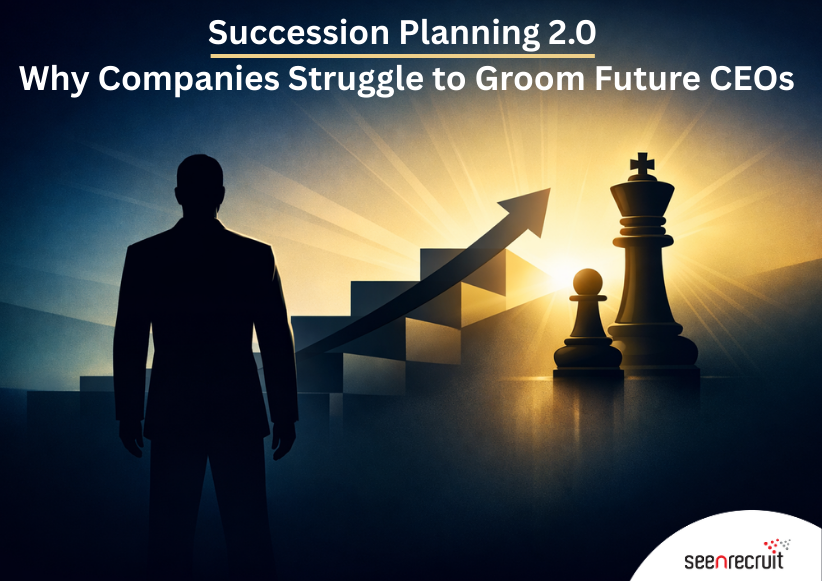


Discover why many organisations still struggle with “Succession Planning 2.0” and fail to groom next-gen CEOs. Explore the five critical barriers to effective leadership pipelines and how to build a future-ready CEO bench in today’s fast-evolving business landscape.
Succession planning has moved far beyond a routine formality; it’s now a strategic necessity that organizations can’t afford to overlook. With elevated expectations for agility, digital fluency, stakeholder engagement, and purpose-driven leadership, organisations must evolve their CEO-succession efforts into a next-generation strategy — what we might call Succession Planning 2.0. Yet, despite the urgency, many companies are falling short of grooming a future CEO ready for tomorrow’s challenges. Let’s unpack why.
Research shows that ineffective succession planning at the C-suite level can cost immense value — one study estimated nearly US$1 trillion in lost market capitalization among the S&P 1500 due to flawed CEO transitions.
The result? A leadership pipeline that lacks depth and readiness when the top job opens up.
Many organisations continue to initiate succession planning only when a CEO exit is imminent — rather than beginning at Day 1.
Some of the most common obstacles:
In short: if you treat succession as a reactive task rather than a strategic discipline, you set yourself up to stumble.
The role of the CEO is evolving fast. The “next-gen” chief executive needs far more than functional excellence: they must be digital-savvy, culturally fluent, resilient, stakeholder-centric, and comfortable with ambiguity.
However, many succession pipelines still reward past achievements (tenure, P&L size) rather than future-readiness. That leads to a mismatch: a high-performing COO or Division Head doesn’t always translate into a future-ready CEO. Boards and incumbent CEOs often underestimate the depth and breadth of experiences required for the top job.
A strong internal successor has advantages — yet many firms default to external hiring under pressure, which the research indicates often underperforms.
Internal development can be neglected because:
All this leads to underinvestment in internal grooming, despite the long-term value of homegrown leaders.
Even with a technical succession framework in place, execution often fails because of cultural friction:
An authentic Succession Planning 2.0 model embeds culture, clarity, and trust into the process — not just talent lists and assessments.
To make Succession Planning 2.0 work, organisations must shift from reactive to proactive, from short-term to strategic, and from senior-only to enterprise-wide. Here are four high-impact actions:
In a world of rapid change — digital disruption, shifting consumer expectations, ESG/sustainability pressures — the traditional “promote when ready” model for CEOs is no longer sufficient. Organisations that embrace Succession Planning 2.0 — with focus on leadership agility, pipeline depth, culture alignment, and strategic foresight — will be far better positioned to groom future CEOs who can lead with purpose, resilience, and relevance.
For firms that don’t take this seriously, the cost is steep: loss of value, cultural disruption, and missed opportunities for growth and renewal.
Let your CEO-succession efforts be a strategic lever, not an HR back-burner item.